Celebs
8 Films and Series That Brought Mahatma Gandhi to Screen

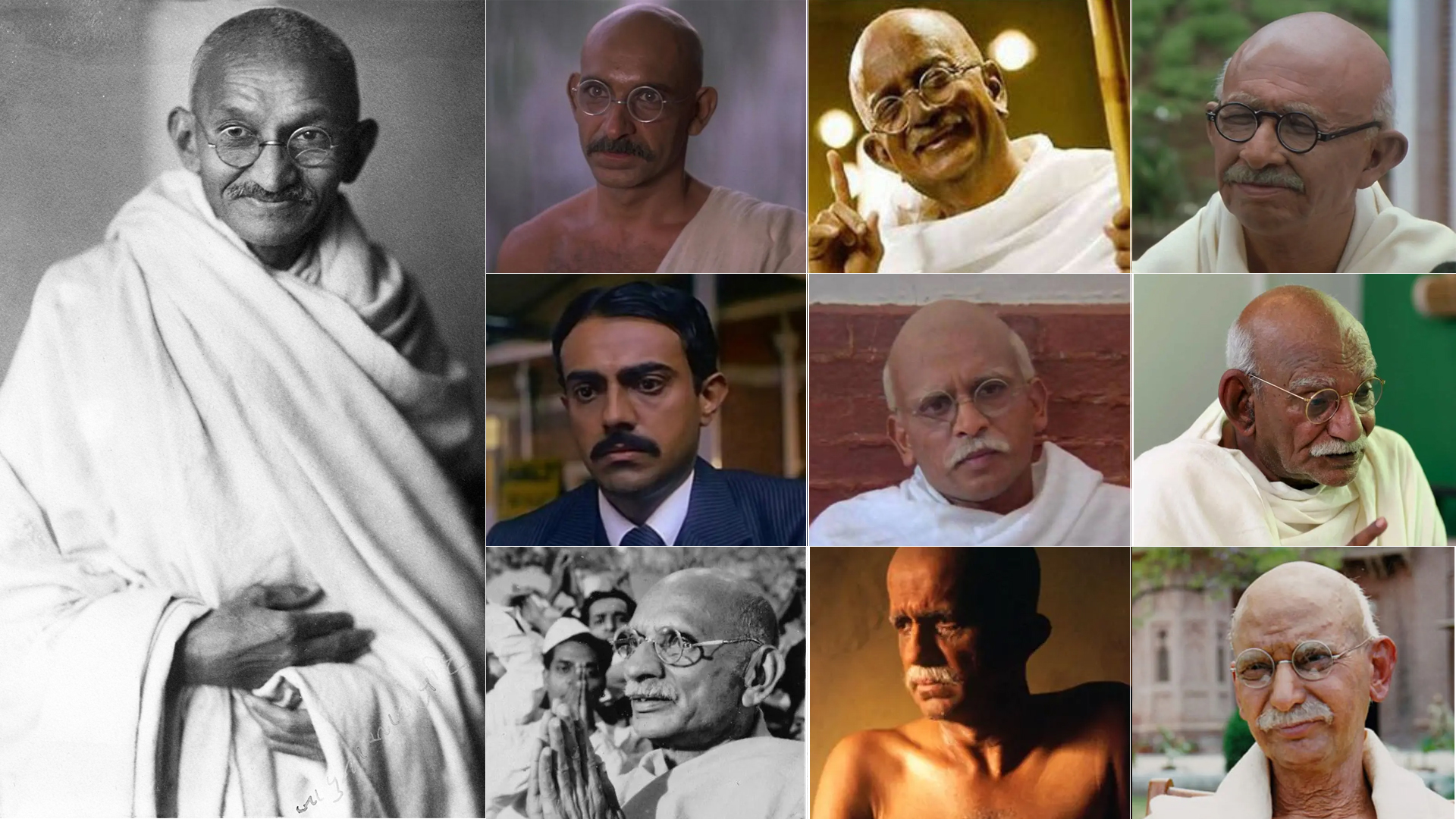
- Ben Kingsley portrayed Mahatma Gandhi in Richard Attenborough’s 1982 film Gandhi.
- Naseeruddin Shah played Gandhi in Kamal Haasan’s Hey Ram (2000).
- Rajit Kapur portrayed the younger Gandhi in Shyam Benegal’s The Making of the Mahatma (1996).
- Darshan Jariwala played Gandhi in Gandhi, My Father (2007), which focused on his relationship with his son Harilal.
- Dilip Prabhavalkar portrayed an imagined Gandhi in Lage Raho Munna Bhai (2006).
- Annu Kapoor, Sam Dastor, J. S. Cashyap and Rajkummar Rao-era Bose: Dead/Alive casting among other screen portrayals.
Mahatma Gandhi has been portrayed on screen in very different ways: as the central figure of an expansive biopic, a younger man finding his political voice, a father struggling with his relationship with his son, and even an imagined moral guide appearing to a modern-day gangster.
Across films spanning decades, actors including Ben Kingsley, Naseeruddin Shah, Rajit Kapur, Darshan Jariwala, Dilip Prabhavalkar and Annu Kapoor have taken on the role. More recent screen projects have continued to revisit Gandhi’s life, including Hansal Mehta’s series featuring Pratik Gandhi.
Ben Kingsley in Gandhi
Richard Attenborough’s Gandhi, released in 1982, remains the most expansive Gandhi portrait among the films discussed in the supplied sources.
Ben Kingsley played the Mahatma, earning the Academy Award for Best Actor. The film itself won eight Oscars, including Best Picture, according to the supplied source material.
The film compresses Gandhi’s life into a little over three hours, with John Briley’s screenplay covering a broad sweep of his story. The sources describe Kingsley’s performance as a defining screen portrayal and note the film’s international reach.
Rajit Kapur in The Making of the Mahatma
Shyam Benegal’s 1996 film The Making of the Mahatma took a different route. Rather than concentrating on Gandhi as the established Mahatma, the film followed his early years in South Africa and the experiences that shaped his later philosophy.
Rajit Kapur played Gandhi. The supplied sources describe his performance as convincing and note that he won the National Film Award for Best Actor for the role.
The film was adapted from Fatima Meer’s The Apprenticeship of a Mahatma, according to one of the supplied sources.
Naseeruddin Shah in Hey Ram
In Kamal Haasan’s Hey Ram (2000), Gandhi is not the central character, but he becomes an important presence as the story approaches the assassination.
Naseeruddin Shah played Gandhi. The supplied material highlights his portrayal and specifically notes the response to his Gujarati accent.
The film offers a different screen interpretation from the conventional biopic: Gandhi appears within a historical drama built around communal tensions and the events surrounding his assassination.
Dilip Prabhavalkar in Lage Raho Munna Bhai
Lage Raho Munna Bhai (2006) brought Gandhi into a contemporary setting.
Dilip Prabhavalkar played an imagined version of Gandhi who appears to Sanjay Dutt’s character, Munna Bhai, and acts as a moral guide. The supplied sources describe Prabhavalkar’s performance as gentle and understated, with particular attention to his voice and mannerisms.
The film’s approach was less about recreating Gandhi’s historical life and more about placing Gandhian ideas inside a modern story.
The supplied source batch contains a conflicting identification for the Gandhi role in this film, with another source naming Surendra Rajan. Because the sources do not agree, the attribution is not treated as independently settled here.
Darshan Jariwala in Gandhi, My Father
Feroz Abbas Khan’s Gandhi, My Father (2007) shifted attention from Gandhi the national figure to Gandhi the father.
Darshan Jariwala played Gandhi, while the story focused heavily on his troubled relationship with his eldest son, Harilal Gandhi. The supplied material describes the film as an exploration of the tension between Gandhi’s public responsibilities and his relationship with his family.
Anil Kapoor produced the film, according to the source batch.
Annu Kapoor in Sardar
Gandhi also appeared as a supporting figure in films centered on other leaders of the independence movement.
In Sardar (1993), Annu Kapoor played Gandhi. The film primarily focused on Sardar Vallabhbhai Patel, played by Paresh Rawal, while Gandhi appeared as an important figure in the story.
The supplied sources identify Ketan Mehta as the director and note that the film received two National Film Awards, including Best Film on National Integration.
Other portrayals
Sam Dastor portrayed Gandhi in the 1986 British miniseries Lord Mountbatten – The Last Viceroy. J. S. Cashyap played Gandhi in Nine Hours to Rama (1963), a film centered on the events leading up to his assassination.
Surendra Rajan is also identified in the source batch as having portrayed Gandhi in Bose: Dead/Alive (2017), alongside Rajkummar Rao.
These appearances underline how often Gandhi has entered stories in which he was not necessarily the principal character.
Pratik Gandhi takes on the role
The most recent project discussed in the supplied sources is Hansal Mehta’s series Gandhi, starring Pratik Gandhi.
The material says the series is based on the books and research of Ramachandra Guha and follows Gandhi from his early years through his experiences in South Africa and the Indian independence movement. It also describes the project as a multi-season series featuring the people around Gandhi and the events that shaped his life.
The source batch contains differing references to the project’s year, identifying it as both Gandhi (2025) and Gandhi (2026). It also states that the series premiered at the 50th Toronto International Film Festival in 2025.
Pratik Gandhi’s casting adds another interpretation to a role that has already been played by actors from several generations and in markedly different kinds of stories.
From Kingsley’s large-scale biographical performance to Prabhavalkar’s imagined Gandhi and Jariwala’s portrayal of a father caught between public duty and family, the screen versions have approached the same historical figure from very different angles.