Reviews
Operation Safed Sagar: Real Story Behind Netflix’s Kargil Drama

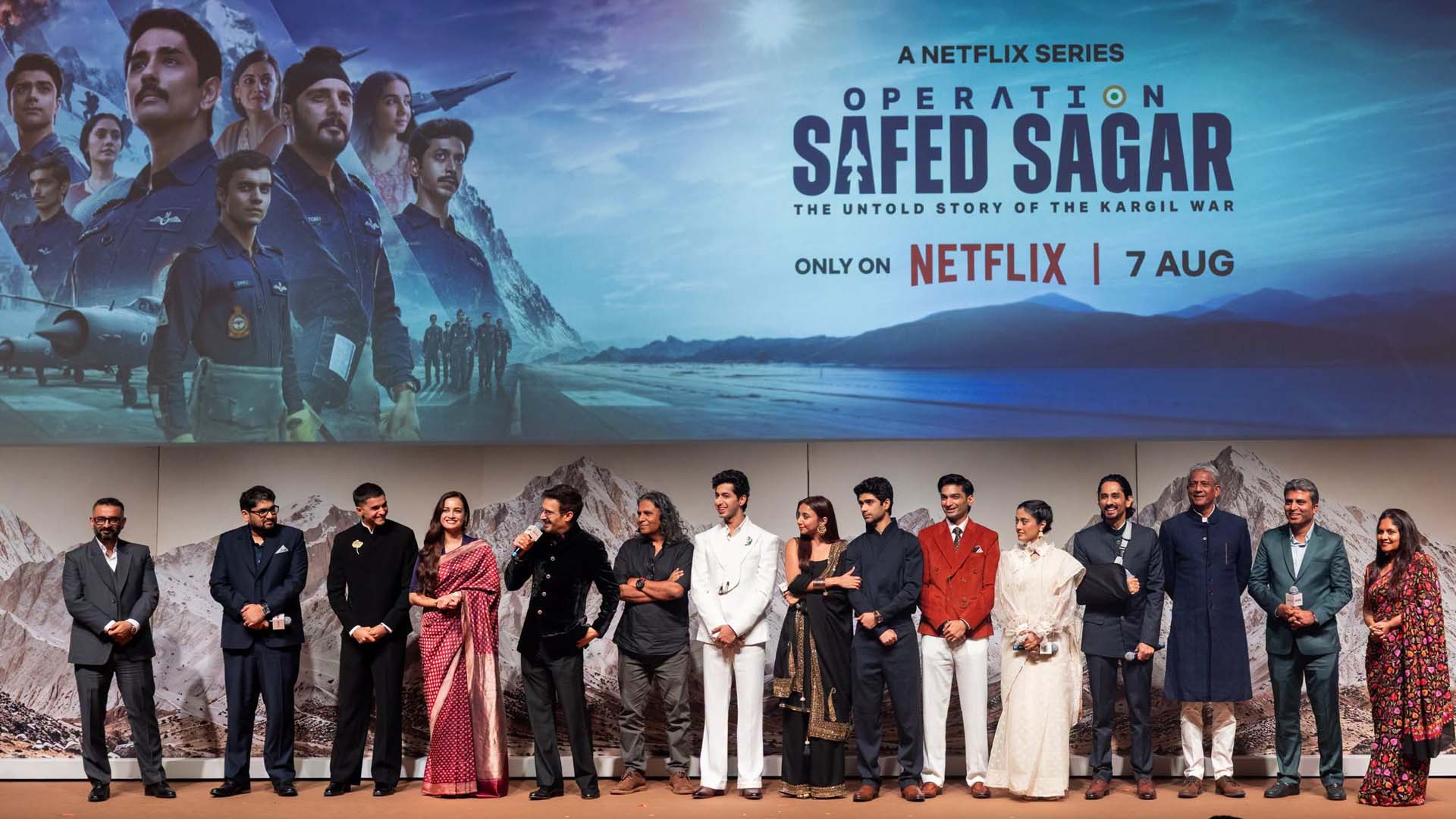
- Netflix’s Operation Safed Sagar is inspired by the Indian Air Force’s role in the 1999 Kargil War.
- The series recreates the Golden Arrows’ missions, led by Wing Commander B.S. Dhanoa and Squadron Leader Ajay Ahuja.
- Atal Bihari Vajpayee’s February 1999 bus journey to Lahore and the Lahore Declaration were real events.
- Nawaz Sharif’s knowledge of the Kargil operation remains disputed, with sharply different accounts from Sharif and Pervez Musharraf.
- R&AW interceptions of conversations involving Musharraf and Lt Gen Mohammad Aziz became important evidence of Pakistani military involvement.
- Operation Safed Sagar began on May 26, 1999, with the IAF operating under orders not to cross the Line of Control.
Netflix’s Operation Safed Sagar revisits one of the lesser-told chapters of the 1999 Kargil War: the Indian Air Force’s high-altitude campaign and the pilots of No. 17 Squadron, the Golden Arrows. The six-episode series, directed by Oni Sen and created by Abhijeet Singh Parmar and Kushal Srivastava, stars Siddharth as Squadron Leader Ajay Ahuja and Jimmy Shergill as Wing Commander B.S. Dhanoa. Netflix says the drama was developed through extensive research and consultations with IAF veterans, including Dhanoa himself.
The central military events are rooted in history. In May 1999, Indian forces discovered that Pakistani troops had occupied strategic heights on the Indian side of the Line of Control in the Kargil sector. The IAF was called in to support the Army, launching Operation Safed Sagar on May 26. The campaign became the first major use of Indian air power at such extreme altitudes and was conducted under the crucial restriction that Indian aircraft would not cross the LoC.
The series also draws heavily on the political events that preceded the fighting — a period when India and Pakistan appeared to be moving toward a diplomatic breakthrough.
Vajpayee’s Lahore Bus Journey Was Real
In February 1999, Prime Minister Atal Bihari Vajpayee travelled to Lahore on the inaugural Delhi-Lahore bus service after an invitation from Pakistan Prime Minister Nawaz Sharif.
The journey took place on February 20, with Vajpayee personally taking the first bus to Pakistan. During the visit, the two prime ministers held talks and signed the Lahore Declaration on February 21, committing both countries to confidence-building measures, peaceful relations and implementation of the Simla Agreement. A United Nations statement at the time specifically noted Vajpayee’s decision to inaugurate the service personally.
The timing is central to the historical irony portrayed in Operation Safed Sagar. Within months of the peace initiative, the Kargil conflict had erupted.
The Pakistani military had already been preparing an operation to occupy high-altitude positions vacated during winter. Accounts of the planning identify then-Army chief Pervez Musharraf and a small group of senior officers as central figures in the operation.
The Musharraf-Vajpayee Snub Also Has a Historical Basis
The series depicts a strained encounter between Vajpayee and Musharraf during the Lahore visit.
Contemporary reporting supports the broader incident: Pakistan’s three service chiefs, including Musharraf, did not go to the Wagah border to receive Vajpayee, a departure from expected protocol that attracted attention at the time. The episode was still being cited during the 2001 Agra Summit, when Indian Air Chief Marshal A.Y. Tipnis notably did not salute Musharraf during the ceremonial reception.
The precise staging of the encounter in the Netflix series is dramatized, but the underlying diplomatic slight is not simply a fictional invention.
Did Musharraf Keep Nawaz Sharif in the Dark?
This remains one of the most contested parts of the Kargil story.
Operation Safed Sagar presents Musharraf as driving the operation while keeping Nawaz Sharif largely uninformed. Nawaz Sharif later gave an account broadly consistent with that portrayal.
In a 2007 interview with journalist Shekhar Gupta, Sharif said he first learned the extent of the fighting when Vajpayee contacted him. He maintained that Musharraf had kept the operation secret from him and other senior figures and said he was shocked to learn that regular Pakistani troops were engaged in Kargil.
Musharraf offered a different version.
In a 2006 interview cited in accounts of the conflict, Musharraf pointed to photographs of Sharif visiting the Kel sector on February 5, 1999. He argued that Sharif had been briefed by senior military officers and had even addressed troops there. That evidence is central to Musharraf’s contention that the prime minister knew about the operation before the Lahore visit.
The historical record therefore does not support presenting the dispute as conclusively settled. Sharif said he had been kept in the dark; Musharraf insisted that Sharif had been briefed. What is clear is that the question of civilian knowledge became one of the defining controversies surrounding Kargil and later contributed to the political confrontation between Sharif and Musharraf.
The Intercepted Conversations That Undercut Pakistan’s Public Narrative
One of the most consequential intelligence episodes of the war involved telephone conversations between Musharraf and Lt Gen Mohammad Aziz Khan, then Pakistan’s Chief of General Staff.
According to accounts of the conflict, Musharraf was in Beijing during the latter part of May 1999 and maintained regular telephone contact with Aziz in Rawalpindi. Indian intelligence intercepted the conversations. Portions of the recordings were subsequently made public by the Indian government.
The intercepts mattered because Pakistan had initially portrayed the fighters in Kargil as Kashmiri militants rather than regular Pakistani troops. The conversations provided evidence used by India to argue that Pakistan’s military establishment was directly involved in planning and conducting the operation.
The broader question of how much Pakistan’s civilian leadership knew remained contested, but the intercepted communications became an important part of India’s diplomatic case during the conflict.
The Golden Arrows and the Real Pilots
At the heart of the Netflix story is No. 17 Squadron, known as the Golden Arrows.
During Kargil, the squadron was commanded by Wing Commander B.S. Dhanoa. Official government material records that under his leadership the unit developed innovative methods for bombing at high altitude and at night. Dhanoa received the Yudh Seva Medal for his conduct during the conflict and later went on to become Chief of the Air Staff in 2016.
Siddharth plays Squadron Leader Ajay Ahuja, the squadron’s flight commander. Ahuja’s real story became one of the most tragic episodes of Operation Safed Sagar.
On May 27, 1999, Ahuja was flying a reconnaissance mission when he learned that Flight Lieutenant K. Nachiketa had ejected after his aircraft was hit. Rather than immediately returning to base, Ahuja remained in the area to try to locate the missing pilot. His MiG-21 was subsequently hit by a surface-to-air missile. The IAF’s gallantry record states that he continued searching despite the missile threat and was later killed. He was posthumously awarded the Vir Chakra.
The series also draws on the experiences of other Golden Arrows pilots, including Flying Officer R.S. Dhaliwal, Flying Officer C.H. Bal Reddy, Flight Lieutenant Jitendra Sangwan and Flying Officer Amit Gupta. Netflix identifies these characters as part of the young pilot group depicted alongside Dhanoa and Ahuja.
How the IAF Fought at Kargil
Operation Safed Sagar presented a unique operational challenge. Aircraft had to strike positions embedded in steep mountainous terrain while Indian commanders were determined not to widen the conflict by crossing the LoC.
The IAF deployed several aircraft types during the campaign, including MiG-21s, MiG-23s, MiG-27s, Jaguars, Mirage 2000s, MiG-29s and Mi-17 helicopters. Government records note that the Mirage 2000 was used for precision strikes, including attacks employing laser-guided bombs.
The difficult terrain forced the IAF to adapt its tactics. Dhanoa’s squadron initially conducted reconnaissance missions before shifting to bombing operations. Official award records say the unit rapidly reconfigured its MiG-21s for the bombing role and achieved accurate attacks against enemy positions.
The air campaign subsequently became an important component of India’s effort to recapture the occupied heights.
What Operation Safed Sagar Changes for Drama
The Netflix series is not a documentary, and some scenes necessarily compress complicated political and military history into dramatic encounters.
Its portrayal of Musharraf as the central architect of the Kargil operation reflects a widely established historical assessment, but the extent of Nawaz Sharif’s prior knowledge remains disputed. The series chooses one side of that debate for dramatic purposes rather than presenting every competing interpretation.
That distinction matters because Kargil was not simply a story of battlefield action. It involved a failed diplomatic opening, a covert military operation, competing claims within Pakistan’s civil-military establishment and an international effort to prevent the conflict from escalating.
The real story behind Operation Safed Sagar is therefore larger than the aerial combat shown on screen. It is the story of how a brief period of India-Pakistan rapprochement was followed by one of the most difficult military campaigns of the post-independence era — and how the Golden Arrows became part of that history.
Netflix released the six-episode series globally on August 7, 2026.